New Delhi, Nov 25: The Centre has launched a nationwide skill development initiative to train and certify at least one lakh rural youth as ‘Nal Jal Mitras’, creating a skilled local workforce to maintain village drinking water supply systems under Jal Jeevan Mission 2.0.
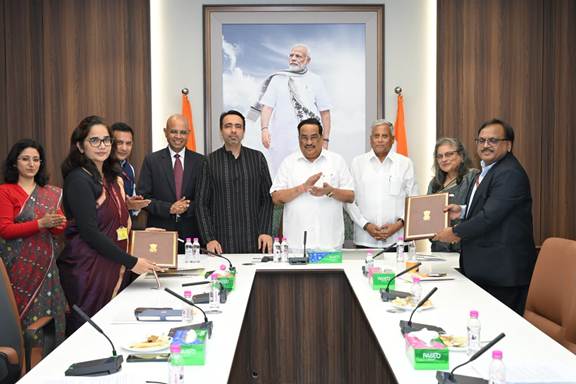
The Department of Drinking Water and Sanitation (DDWS), under the Ministry of Jal Shakti, on Wednesday signed a Memorandum of Understanding (MoU) with the Directorate General of Training (DGT), Ministry of Skill Development and Entrepreneurship, to roll out the Water Supply Operation and Maintenance Skilling Programme.
The agreement was signed in the presence of Union Jal Shakti Minister C. R. Patil, Minister of State for Jal Shakti V. Somanna and Minister of State for Skill Development and Entrepreneurship Jayant Chaudhary in New Delhi.
Swati Meena Naik, Joint Secretary, National Jal Jeevan Mission, and Sunil Kumar Gupta, Deputy Director General, DGT, formally signed the MoU. Senior officials from both ministries, including their respective secretaries, were also present.
One lakh candidates to receive specialised training
The programme aims to train and certify at least 1,00,000 candidates during the extended period of Jal Jeevan Mission. It carries an estimated financial outlay of ₹111.93 crore, which will be fully funded by DDWS through its departmental expenditure.
The initiative will use the existing network of Industrial Training Institutes (ITIs) and National Skill Training Institutes (NSTIs) to build technical capacity in rural areas. It is designed to ensure that trained personnel are available close to villages to address routine maintenance and operational problems in piped water supply systems.
The initiative assumes added importance as nearly 16 crore rural households have been connected to tap water supply systems, according to DDWS Secretary Ashok K. K. Meena. He said the next priority is to establish a dependable operation and maintenance mechanism to keep these assets functional over the long term.
Meena said the partnership would link the country's vocational training infrastructure with the rural drinking water sector through classroom instruction and practical exposure at operational village water supply schemes.
165-hour course combines classroom learning with field experience
The training curriculum has been designed as a 165-hour, National Skills Qualifications Framework (NSQF)-aligned short-term course. Developed by the Central Staff Training and Research Institute (CSTARI) under DGT, in consultation with DDWS, it has received approval from the National Council for Vocational Education and Training (NCVET).
The course will include 120 hours of institutional training, covering theory and practical sessions, followed by 45 hours of mandatory on-the-job training at functioning rural piped water supply schemes.
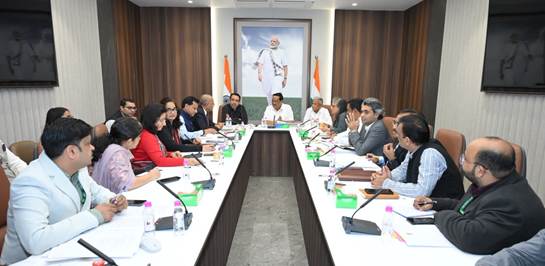
The programme will be offered as an optional elective to existing and former trainees of the Fitter and Plumber trades under the Craftsmen Training Scheme at government ITIs and NSTIs.
Candidates who successfully complete the course will receive an NSQF-aligned Short-Term Training certificate from DGT, in addition to their National Trade Certificate.
The curriculum will cover plumbing, water distribution networks, pumps and motors, basic electrical work, water quality monitoring and routine operation and maintenance activities. Field training will help participants develop practical skills in addressing challenges encountered in village-level water supply systems.
Certified workforce to support village-level maintenance
The National Instructional Media Institute (NIMI), a subordinate office of DGT, will function as the programme's Training Partner. It will coordinate training activities and handle fund disbursement, assessment and certification.
DDWS will facilitate the orientation of trainers and identification of suitable sites for on-the-job training. It will also make the database of certified candidates available to district administrations and Gram Panchayats, allowing States and Union Territories to engage trained personnel for operation and maintenance roles in line with their respective human resource policies.
A Joint Steering Committee, chaired by an officer of the rank of Joint Secretary or above from DDWS, will supervise implementation, monitor training targets and review utilisation of funds.
The Union Ministers welcomed the collaboration, highlighting its potential to strengthen rural water supply services while opening up employment opportunities for young people. The initiative also reflects a coordinated government approach by bringing together the rural drinking water and vocational training systems.
By creating a pool of locally trained and certified Nal Jal Mitras, the programme seeks to reduce dependence on external technical support for routine repairs and maintenance. It is expected to strengthen the long-term functioning of rural tap water infrastructure, improve service delivery at the village level and provide new livelihood opportunities to rural youth.