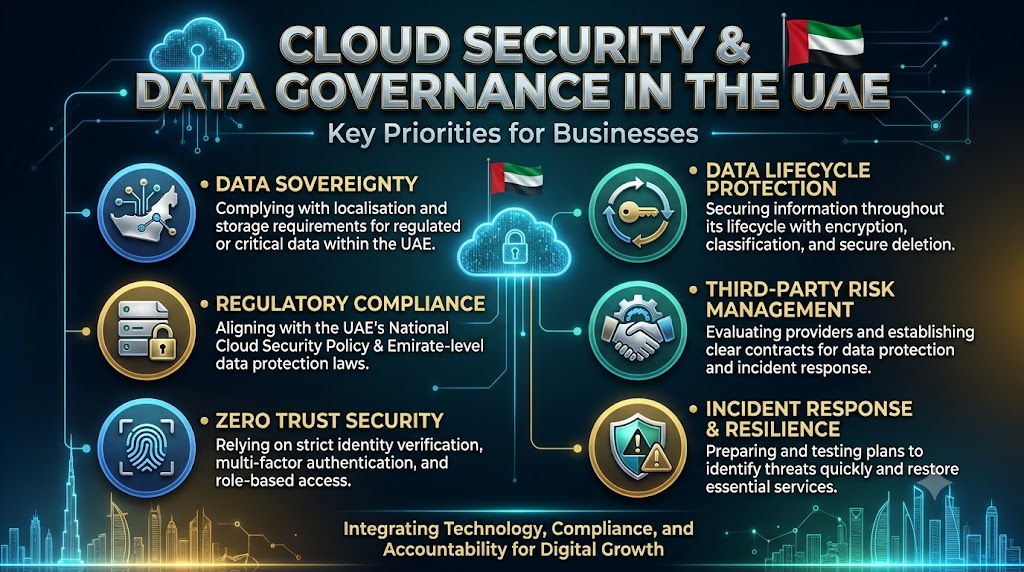
Cloud security and data governance in the UAE are becoming essential business priorities as companies move more operations, customer information and critical applications to cloud platforms. While cloud technology helps organisations reduce infrastructure costs, improve collaboration and scale their services, it also creates new responsibilities for protecting sensitive information and complying with data protection requirements. For businesses operating in the UAE, managing these risks involves more than installing cybersecurity software. Companies must understand applicable regulations, control access to information, monitor third-party providers and establish clear rules for how data is collected, stored, processed and shared.
Why Cloud Security Matters for UAE Businesses
Cloud computing has become an important part of business operations across sectors such as banking, healthcare, retail, logistics and professional services. Companies use cloud platforms to manage customer records, run applications, analyse business information and support employees working across different locations.
However, moving data to the cloud does not eliminate security risks. Weak access controls, incorrect system configurations, compromised accounts and third-party vulnerabilities can expose confidential information to unauthorised access.
A security incident can lead to financial losses, operational disruption, reputational damage and potential regulatory consequences. For businesses handling sensitive customer or government information, the impact can be particularly serious.
A strong cloud security strategy therefore needs to be part of overall business management. It should cover technology, employee responsibilities, risk assessment and the procedures used to respond when something goes wrong.
Understanding the UAE's Data Protection and Cloud Regulations
The UAE has established regulatory frameworks that influence how organisations manage cloud environments and protect information. Companies must identify which requirements apply to their activities, the type of data they handle and the jurisdictions in which they operate.
The UAE's National Cloud Security Policy provides a framework for addressing security requirements associated with cloud services, particularly within its applicable government and critical-sector context. The UAE Personal Data Protection Law also establishes requirements concerning the processing and protection of personal data, subject to its scope and applicable exemptions.
Businesses operating in Dubai and Abu Dhabi may also need to consider relevant emirate-level requirements and sector-specific regulations. For example, organisations within the scope of Dubai's electronic security requirements must assess the applicable standards and controls, while regulated financial institutions and healthcare providers may face additional obligations.
Compliance should not be treated as a one-time exercise. As businesses adopt new cloud applications, expand into new markets or change service providers, their regulatory responsibilities and security risks may also change.
Data Sovereignty and Localisation Require Careful Planning
Data sovereignty has become an important consideration for companies operating in the UAE. It concerns the legal and regulatory authority governing data, while data localisation generally refers to requirements to store or process information within a particular geographical location.
For some organisations, particularly those handling government, critical or regulated information, where data is stored and who can access it can directly influence cloud architecture decisions.
Businesses should classify information according to its sensitivity and identify any applicable requirements governing storage, processing, transfers and access. They should also understand where cloud providers keep primary data, backups, disaster recovery copies and relevant metadata.
Keeping data within the UAE may be necessary in particular circumstances, but it should not be assumed that every category of business information is subject to the same localisation requirement. Companies need to assess the rules applicable to their sector, data type and contractual obligations before selecting a cloud service.
This early planning can help prevent costly system changes and reduce the risk of compliance problems during future expansion.
Strong Identity Controls and Zero Trust Security
Traditional security approaches often rely heavily on protecting a company's network perimeter. In cloud environments, however, employees, contractors, applications and external service providers may access systems from different locations and devices.
Identity and access management has consequently become a central part of cloud protection.
Businesses should use multi-factor authentication, role-based access controls and strict approval processes for privileged accounts. Employees should receive only the permissions necessary to perform their responsibilities, while access should be reviewed regularly and removed when no longer required.
Zero Trust security provides an additional framework by requiring access requests to be evaluated rather than automatically trusted because they originate from a familiar network. Depending on the organisation's risk profile, this can involve checking identity, device security, access context and the sensitivity of the requested resource.
These measures can reduce the likelihood that a compromised account will provide unrestricted access to business systems.
Protecting Data Throughout Its Lifecycle
Effective data governance extends beyond deciding where information is stored. Businesses also need to understand how data moves through their systems, who uses it and when it should be retained or deleted.
Encryption helps protect information when it is stored and transmitted. Appropriate key management is equally important because weakly controlled encryption keys can undermine otherwise strong security measures.
Companies should also maintain visibility into cloud applications, application programming interfaces, system configurations and data transfers. Regular reviews can identify publicly exposed storage, excessive permissions and other weaknesses before they result in serious incidents.
Data classification, retention schedules and secure deletion procedures are important parts of this process. By establishing clear rules for handling information, organisations can limit unnecessary exposure and make it easier to demonstrate accountability.
Managing Cloud Service Providers and Third-Party Risks
Many businesses depend on external cloud providers, software vendors and technology partners to operate their digital services. Although these relationships can improve efficiency, they can also introduce risks beyond the company's direct control.
Before selecting a provider, organisations should evaluate its security capabilities, compliance commitments, incident notification procedures and ability to support business continuity. Contracts should clearly define responsibilities for data protection, access management, breach reporting and service availability.
Businesses should also understand how data can be retrieved or transferred if they decide to change providers. Clear arrangements for data portability and secure deletion can help reduce vendor dependence and avoid operational difficulties.
Third-party risk management should continue throughout the relationship. Periodic assessments, contract reviews and monitoring of important service dependencies can help businesses respond when a provider's security posture or operating arrangements change.
Incident Response and Business Continuity
Even well-protected cloud environments cannot eliminate every cyber threat. UAE companies need practical plans for responding to incidents, limiting damage and restoring essential services.
Depending on their size and risk exposure, businesses may establish an internal security operations centre, work with a managed detection and response provider, or use a combination of both. The objective is to identify suspicious activity quickly and ensure that the appropriate people can respond.
An effective incident response plan should define responsibilities, escalation procedures, communication channels and recovery priorities. It should also address the preservation of evidence and any applicable regulatory or contractual notification obligations.
Regular exercises and backup recovery tests are equally important. A backup strategy provides limited protection if the organisation cannot restore its systems or if backup data has also been compromised.
For smaller businesses without large security teams, external specialists and managed services can provide additional expertise. However, responsibility for risk decisions, governance and regulatory accountability must remain clearly assigned within the organisation.
Making Data Governance Part of Everyday Business Operations
Technology controls are only one part of effective governance. Employees also need to understand how information should be handled and why security policies matter.
Companies should assign clear responsibility for data ownership, access approvals, retention and compliance monitoring. Training should address practical risks such as phishing, unsafe file sharing, weak passwords and the use of unapproved cloud applications.
Management teams should regularly review security incidents, audit findings, access permissions and changes in business operations. These reviews can help identify weaknesses and ensure that policies remain relevant as the organisation grows.
Good governance can also improve operational efficiency. When information is properly classified, consistently maintained and accessible to authorised users, businesses can reduce duplication, improve decision-making and manage information more effectively.
Conclusion
Cloud security and data governance in the UAE are no longer issues that businesses can leave solely to their IT departments. They are essential elements of risk management, regulatory compliance and customer trust in an increasingly digital economy.
Companies that understand their data responsibilities, implement strong access controls, assess third-party providers and prepare for security incidents can reduce exposure while making better use of cloud technology. Their approach must also reflect the regulations applicable to their sector, the sensitivity of their information and the way their operations are structured.
The long-term objective is to make security and governance part of everyday business decisions. By combining appropriate technology with clear accountability and regular risk reviews, UAE companies can protect valuable information, strengthen operational resilience and build a more dependable foundation for digital growth.

