New Delhi, Nov 04: As organisations focus on productivity, performance and employee experience, new research from Compass Group India suggests one of the most effective enablers of workplace performance may be increasingly overlooked: the workday break.
According to Compass Group India's latest Global Eating at Work (GEAW) study, 95% of Indian employees report feeling more productive after taking a break, yet 63% believe breaks remain undervalued within their organisation. The findings point to a growing disconnect between what employees know supports performance and what workplace cultures actively enable.
The study indicates that while awareness around wellbeing is increasing, opportunities to pause, recharge and disconnect during the workday are becoming less common. Employees taking regular breaks three to five times a week have declined from 46% in 2023 to 38% in 2025, while nearly a quarter of employees admit they rarely take a meaningful break during the day.
Productivity Is No Longer Just About Hours Worked
The findings come at a time when organisations across India are reassessing productivity, workforce engagement and employee wellbeing. While technology and flexible work models continue to reshape how work gets done, employees increasingly view breaks, nutrition, movement and social connection as critical contributors to performance.
Compass Group India's research found that 76% of employees prefer multiple shorter breaks over a single long break, reflecting the rise of more dynamic, fast-paced working patterns. However, 45% say they only take breaks when circumstances allow, suggesting that workload pressures continue to influence everyday wellbeing behaviours.
The research also highlights an important public health and workplace risk. Nearly one in four employees continues to eat lunch at their desk, while longer breaks are becoming increasingly rare. The trend raises broader questions about employee recovery, workplace stress and burnout prevention in modern organisations.
Indian Employees Are Looking Beyond Pay to Everyday Wellbeing
The study suggests employee expectations are evolving beyond traditional compensation and benefits. Today's workforce increasingly expects employers to support healthier lifestyles through workplace design, dining experiences, movement opportunities and social spaces.
More than 90% of employees say they are actively changing what they eat and drink to improve their long-term health, while 90% want healthier food choices available in the workplace. Nutrition, physical activity and quality sleep emerged as the three most important drivers of long-term wellbeing among Indian employees.
At the same time, India remains one of the world's most sleep-deprived populations, with 39% of employees reporting fewer than six hours of sleep per night, underscoring the growing importance of workplace strategies that support holistic wellbeing.
Food Is Emerging as a Strategic Lever for Employee Experience
The research highlights the growing role of workplace dining in fostering connection, collaboration and wellbeing.
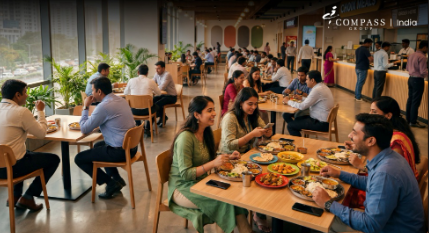
India now significantly outperforms global averages in workplace dining infrastructure, with 51% of employees having access to on-site dining facilities compared with a global average of 29%. In addition, 93% of Indian employees report sharing meals with colleagues at least a few times each month, reinforcing the continued importance of food in building culture and workplace relationships.
Employees are also seeking more personalised and experiential dining environments. Nearly 87% want workplace restaurants to reflect the experience and ambience of modern high-street dining destinations, while growing demand for regional cuisines, healthy snacking and digital ordering solutions is transforming expectations of workplace food services.
Rahul Shinde, Managing Director, Compass Group India, said:
"The future of workplace performance is closely linked to everyday employee experiences. Our research shows that people clearly understand the value of taking breaks, eating well and having opportunities to connect during the workday, yet many struggle to prioritise them amid growing workloads. For employers, this is no longer simply a wellbeing conversation. It is increasingly a productivity, engagement and talent-retention imperative. Organisations that design workplaces around human performance, not just operational efficiency, will be better positioned to build resilient and high-performing teams."
Manika Awasthi, Chief People and Safety Officer, Compass Group India, added:
"Employee experience is shaped by the small choices people make every day. Whether employees feel comfortable taking a break, stepping away for lunch, moving during the day or connecting with colleagues has a direct impact on engagement and wellbeing. "The organisations that will lead the future of work are those that make healthy behaviours a natural part of how work gets done, creating workplaces where people can thrive and perform at their best.”
As India navigates changing workforce expectations, hybrid work patterns and increasing focus on employee wellbeing, the findings suggest that productivity and wellbeing are becoming increasingly interconnected. For employers, supporting healthier habits through workplace culture, food, spaces and experiences may represent one of the most accessible opportunities to improve workforce performance, engagement and long-term organisational resilience.
Additional media headlines that journalists could independently lift:
- 95% of Indian employees say breaks improve productivity, but 63% say workplace cultures still undervalue them.
- One in five Indian employees spends less than 15 minutes on their main workday break.
- 90% of Indian employees want healthier workplace food options.
- 39% of Indian employees sleep less than six hours a night.
- India's workforce is shifting towards healthier snacks, regional cuisines and micro-breaks.
- Workplace dining emerging as a strategic employee experience differentiator in India.

