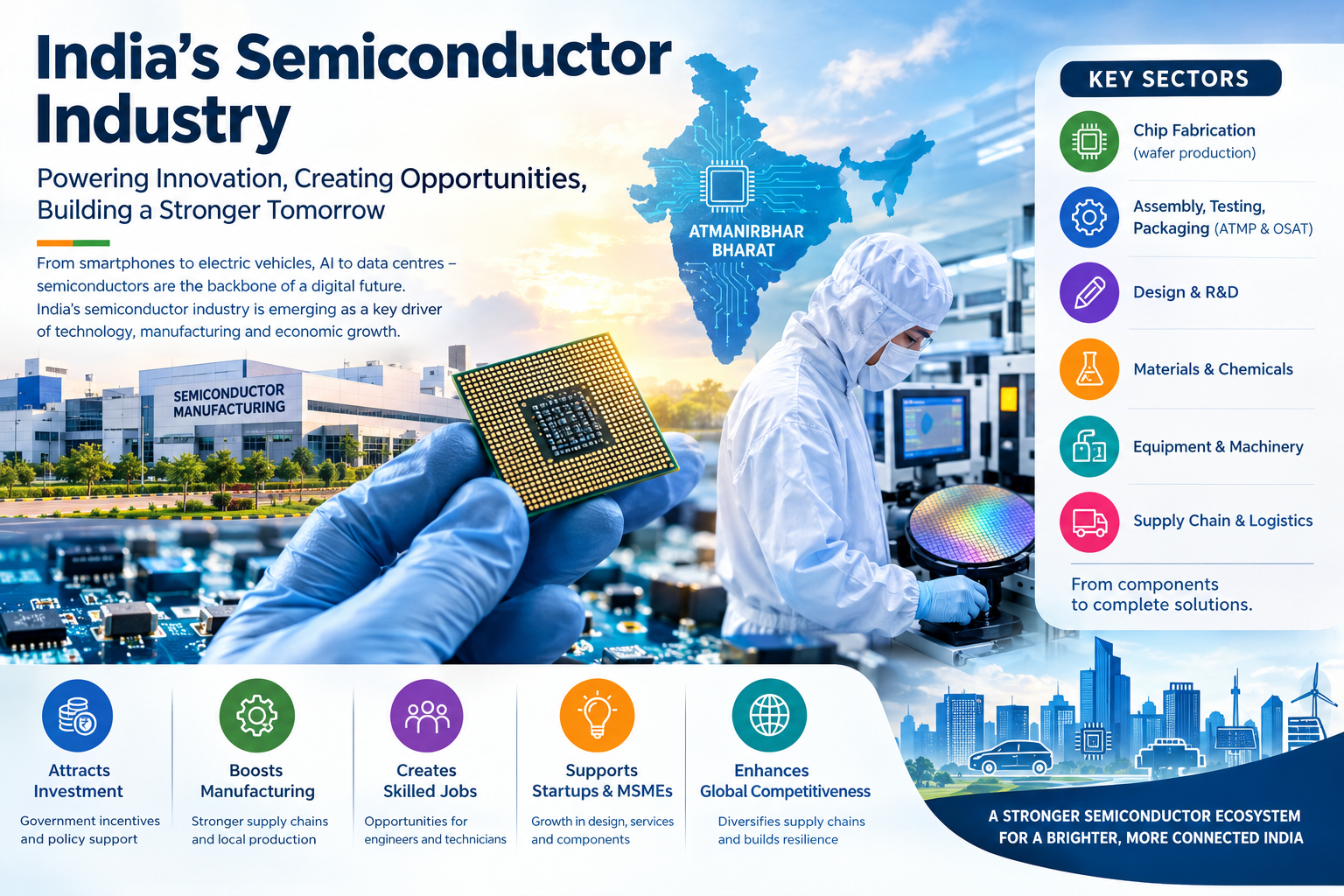
India’s semiconductor industry is emerging as an important driver of the country’s technology and manufacturing ambitions. As demand for smartphones, electric vehicles, artificial intelligence, data centres and connected devices continues to grow, the need for reliable chip supplies is creating new opportunities for domestic manufacturing, investment and innovation.
For India, semiconductor manufacturing is about more than producing electronic components. It represents an opportunity to strengthen supply chains, attract global technology companies, create skilled jobs and help local businesses move into higher-value manufacturing.
The government’s India Semiconductor Mission, backed by an initial outlay of ₹76,000 crore, has provided a foundation for building this ecosystem. Policy support, financial incentives and partnerships with international technology companies are encouraging investments in chip fabrication, assembly, testing, packaging and semiconductor design. The next challenge is to convert these investments into commercially sustainable production and a stronger domestic supply network.
Government Support Creates New Business Opportunities
Semiconductor manufacturing requires substantial capital, advanced technology and a dependable supply of electricity, water, specialised materials and equipment. Government incentives have therefore become an important factor in attracting investors to India.
Under the initial semiconductor programme, eligible projects can receive substantial capital expenditure support, subject to scheme conditions. The broader policy approach also encourages semiconductor design, research, manufacturing equipment, materials and advanced packaging.
This support is creating opportunities beyond large chip manufacturers. Companies supplying industrial machinery, cleanroom equipment, chemicals, gases, precision components, testing systems and engineering services could benefit as manufacturing facilities expand.
For Indian businesses, this opens the door to participating in a technology supply chain that has traditionally been concentrated in a limited number of countries. However, suppliers will need to meet demanding standards for product quality, reliability, traceability and delivery.
Manufacturing Investments Expand India’s Technology Base
India’s semiconductor ambitions are progressing across different stages of the production process. These include wafer fabrication, assembly, testing, marking and packaging, commonly grouped under ATMP and OSAT operations.
The distinction matters because building a complete semiconductor ecosystem takes time. Fabrication plants manufacture chips on silicon wafers, while assembly and testing facilities prepare chips for use in electronic products. Both are essential, but they require different technologies, investments and skills.
Micron’s semiconductor assembly and test facility in Gujarat represents an important step towards establishing a larger domestic manufacturing base. Other approved projects and investments in different states are expected to strengthen India’s capabilities in chip packaging, specialised semiconductor production and related manufacturing services.
The commercial impact will depend on how quickly these facilities scale production, secure customers and integrate with electronics manufacturers. For businesses supplying smartphones, automobiles, industrial equipment and consumer electronics, a stronger domestic semiconductor ecosystem could eventually improve sourcing options and supply-chain resilience.
Rising Electronics Demand Strengthens the Business Case
India’s expanding electronics market is providing an important demand base for semiconductor-related investment. Domestic electronics production has crossed ₹12 lakh crore, reflecting the growth of mobile phone manufacturing, consumer electronics and other technology products.
Every smartphone, electric vehicle, connected appliance and modern industrial system depends on semiconductor components. Artificial intelligence is adding another source of demand through data centres, servers, networking equipment and specialised computing hardware.
This creates opportunities for manufacturers that can combine semiconductor capabilities with electronics production. Businesses may be able to develop local supplier relationships, reduce dependence on overseas sourcing for selected components and improve coordination between product design and manufacturing.
However, domestic chip production will not immediately eliminate imports. India still depends on international suppliers for many advanced chips, specialised materials and manufacturing technologies. Building a competitive industry will require consistent investment in research, equipment, skilled personnel and production capabilities.
Opportunities for Startups and Small Businesses
The semiconductor expansion is also opening up possibilities for Indian startups and small and medium enterprises. While establishing a fabrication plant requires enormous capital, businesses can enter the wider ecosystem through less capital-intensive activities.
Potential opportunities include chip design, embedded systems, semiconductor testing, electronic design automation services, industrial automation, equipment maintenance, precision engineering and specialised software.
The Design Linked Incentive programme has supported the development of domestic semiconductor design capabilities. Access to design tools, institutional partnerships and startup support can help engineers and entrepreneurs develop intellectual property and create products for domestic and international markets.
Small businesses could also benefit by supplying components, maintaining equipment, providing technical training and supporting cleanroom operations. Nevertheless, entering this supply chain is not straightforward. Certification requirements, customer qualification processes, high precision standards and long investment cycles can create barriers for new suppliers.
Partnerships with established manufacturers, engineering institutions and research centres will be important in helping smaller firms build the expertise required to compete.
Skilled Jobs and a New Generation of Engineers
Semiconductor manufacturing can create employment across engineering, production, quality control, equipment maintenance, research, logistics and facility management. The industry also requires specialists in chip architecture, verification, materials science, electronics and process engineering.
India already has a substantial pool of semiconductor design and electronics engineering talent. Expanding manufacturing could create opportunities for professionals to work across more stages of the technology value chain rather than concentrating mainly on software services and overseas design operations.
The employment benefits will depend on the pace of project implementation and the availability of industry-ready skills. Universities, technical institutes and companies will need to collaborate on practical training, advanced laboratories and specialised courses.
For businesses, the availability of trained workers will be a major factor in determining productivity, production quality and the long-term viability of semiconductor facilities.
Supply-Chain Resilience and Global Competitiveness
Recent disruptions to global supply chains have highlighted the risks of relying heavily on a small number of manufacturing locations. Semiconductors are particularly important because shortages can affect automobile production, electronics manufacturing and industrial operations.
By developing domestic capabilities, India can diversify its sources of supply and strengthen its position in the global electronics industry. The country could also attract companies seeking to diversify manufacturing under the China-plus-one strategy.
Yet global competitiveness will depend on more than subsidies. Reliable infrastructure, predictable regulations, access to advanced technology, efficient logistics and a strong network of component suppliers will be equally important.
India will also need to build deeper links between chip designers, manufacturers, packaging facilities and end-product companies. A connected ecosystem can help reduce costs, improve innovation and make domestic production more attractive to global customers.
The Road Ahead
India’s semiconductor manufacturing push offers significant long-term opportunities for the technology sector, but the industry will take time to mature. Large capital requirements, complex production processes, international competition and rapid technological change remain important challenges.
The next phase of growth will depend on turning announced investments into stable commercial operations, expanding domestic supplier networks and supporting research and development. Encouraging local companies to design and manufacture specialised products will also be essential to building lasting capabilities.
For India’s technology industry, the semiconductor opportunity extends far beyond chip factories. It includes a broader business ecosystem of engineering services, equipment suppliers, electronics manufacturers, startups, training institutions and skilled professionals.
If India can connect these parts effectively, semiconductor manufacturing could become a significant source of industrial investment, higher-value employment and technological innovation, strengthening the country’s ambition to become a more competitive global technology and manufacturing hub.