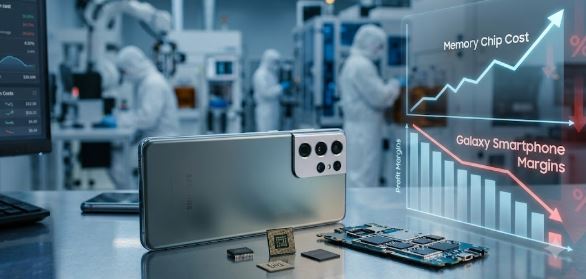
Samsung Electronics is facing a growing cost challenge in its smartphone business as soaring memory-chip prices put pressure on the profitability of its Galaxy devices, even as strong demand for artificial intelligence (AI) chips boosts the company's overall earnings.
The company has benefited significantly from the global AI-driven memory boom. Samsung expects its third-quarter operating profit to reach 107.4 trillion won, up sharply from 12.17 trillion won a year earlier, while quarterly revenue is projected at around 195 trillion won.
However, the surge in memory prices is creating a different picture for the company's smartphone business. Memory is a key component in smartphones, and rapidly rising procurement costs are squeezing margins for Galaxy devices.
Memory Costs Rise Sharply
The sharp increase in memory prices has emerged as one of the biggest challenges for smartphone manufacturers. Strong demand from AI data centres has tightened supplies of memory chips, pushing up prices of DRAM and other components.
For Samsung, this has created an unusual situation where its semiconductor business benefits from higher memory prices, while its smartphone division faces higher costs for the same components.
Industry estimates indicate that mobile memory procurement prices rose significantly during the first half of the year, while smartphone selling prices increased at a much slower pace.
Galaxy Sales Face a Margin Challenge
Samsung's latest Galaxy devices have continued to attract consumer interest, with the Galaxy Z8 series recording strong demand. However, higher sales volumes do not necessarily translate into higher profits when component costs are rising rapidly.
The company has already increased prices for some Galaxy S26 models in response to rising memory costs. However, passing the entire increase on to consumers could affect demand in an increasingly competitive smartphone market.
This leaves Samsung with a difficult balancing act: maintaining competitive smartphone prices while protecting margins in a market where key components are becoming more expensive.
AI Boom Creates a Double-Edged Impact
The situation highlights the contrasting impact of the global AI boom on different parts of Samsung's business.
Strong demand for high-bandwidth memory and other chips used in AI infrastructure is generating substantial growth for the semiconductor division. At the same time, tighter memory supplies and higher prices are raising costs for businesses that use those components, including smartphones.
Samsung's overall third-quarter performance is therefore expected to remain heavily supported by its chip business, while its mobile division faces greater pressure on profitability.
Smartphone Industry Faces Rising Cost Pressure
The development also reflects a broader challenge for the global smartphone industry. Manufacturers must manage higher component costs while consumers remain sensitive to device prices.
With memory demand expected to remain strong, component costs could continue to influence smartphone pricing and profitability in the coming quarters.
For Samsung, the key challenge will be to balance its leadership in the booming memory-chip market with the need to maintain competitive pricing and healthy margins for its Galaxy smartphone portfolio.
The current trend underscores how the AI-driven semiconductor boom is reshaping the electronics industry — creating record opportunities for chipmakers while simultaneously increasing costs for businesses that depend on those chips.