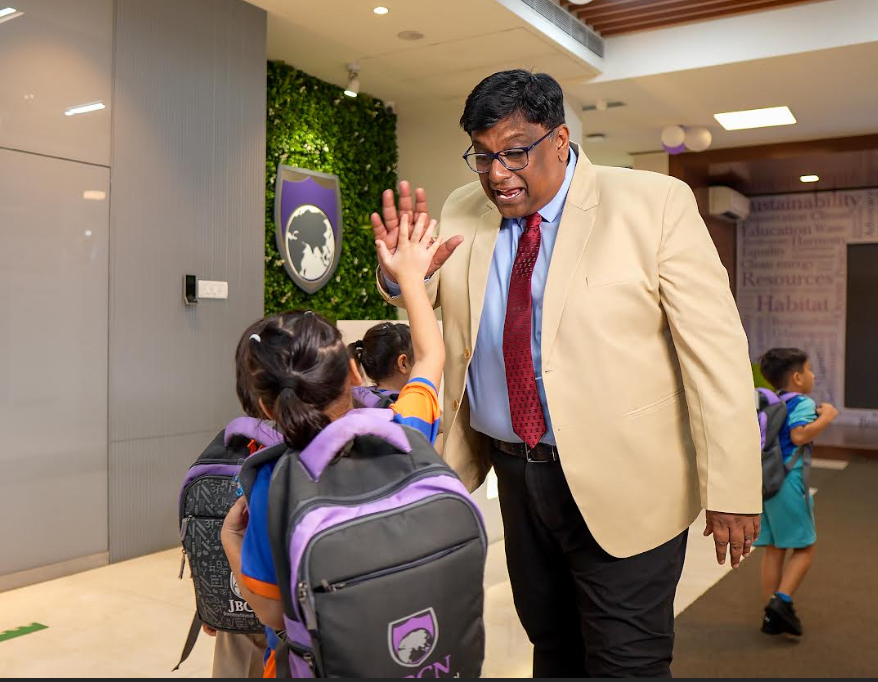
Nirvaan Birla, Managing Director, Birla Open Minds
Education stands at an important inflection point. The world our children are growing up in is fundamentally different from the one our education systems were originally designed for. Technology is transforming industries, artificial intelligence is redefining the nature of work, and the skills required to navigate an increasingly complex world are evolving faster than ever. In this environment, we must ask ourselves an important question: Are we preparing children for the world that exists today, or equipping them to shape the world that is yet to emerge?
For decades, education has largely been structured around the acquisition of knowledge, academic performance and standardised assessments. While these remain important foundations, they can no longer define the entirety of a child's learning journey. The ability to access information is no longer a limitation. What matters increasingly is the ability to interpret that information, question it, apply it meaningfully and translate it into solutions. The purpose of education must therefore evolve from simply imparting knowledge to developing the capabilities that enable individuals to use it.
Moving Beyond the Conventional Classroom
The future of education requires a decisive shift from rote memorisation to conceptual understanding. Children must move beyond learning what to think and develop the ability to think independently. This calls for learning environments that encourage curiosity, questioning, exploration and application.
Project-based learning, collaborative discussions, real-world problem-solving and experiential activities must become integral to the educational experience rather than occasional additions to the curriculum. When children understand how mathematical concepts apply to everyday decisions, how science explains the world around them or how social sciences help them understand society, learning becomes relevant and lasting.
Academic rigour and practical application are not competing priorities. They must complement each other. A strong academic foundation gives children the knowledge to understand the world, while experiential learning gives them the confidence to engage with it.
Building Human Capabilities in an AI-Driven World
Artificial intelligence presents education with both an opportunity and a responsibility. As technology increasingly takes over repetitive and information-driven tasks, distinctly human capabilities will become even more valuable. Creativity, critical thinking, communication, collaboration, empathy and sound judgement will determine how effectively individuals work alongside technology.
We must therefore look at AI not merely as another subject to introduce into the curriculum, but as a development that requires us to rethink the very purpose of learning. Children should understand how to use technology responsibly, evaluate the information it generates and recognise its limitations. More importantly, they must develop the judgement to know when to rely on technology and when independent human thinking is essential.
The objective should not be to create learners who compete with machines, but individuals who can use technology intelligently while bringing imagination, ethics and human understanding to everything they do.
Preparing Learners for Careers That Do Not Yet Exist
One of the biggest challenges before the education system is that we cannot accurately predict what the professional landscape will look like a decade from now. Many of the careers today's children will eventually pursue may not even exist yet. Preparing them for specific job roles alone would therefore be an inadequate approach.
Instead, education must develop the ability to continuously learn, unlearn and relearn. Adaptability, problem-solving, digital literacy, financial awareness and entrepreneurial thinking must become essential components of a future-ready education.
Equally important is the development of emotional intelligence and resilience. The ability to navigate uncertainty, learn from setbacks, work with diverse individuals and approach challenges with confidence is as important as intellectual ability. Children must be encouraged to take initiative, make decisions, understand consequences and develop a sense of responsibility towards the world around them.
Education Must Develop the Whole Individual
At Birla Open Minds, we believe that meaningful education must address the development of the whole individual. Intellectual growth cannot exist in isolation from emotional well-being, physical development, creativity, practical capabilities and values.
Music, sports, performing arts, experiential projects and opportunities for self-expression are not peripheral activities. They are essential avenues through which children discover their interests, build confidence, develop discipline and learn to work with others. Education must create space for different forms of intelligence and recognise that every child has a distinct set of strengths and potential.
This also calls for an evolution in the role of educators. Teachers must increasingly become facilitators, mentors and enablers of learning. Their responsibility extends beyond delivering a curriculum to recognising individual learning needs, encouraging independent thought and creating an environment in which children feel confident enough to explore, question and experiment.
From Academic Achievement to Real-World Readiness
Reimagining education does not mean moving away from academic excellence. It means expanding our definition of what excellence represents. Academic achievement must be accompanied by the ability to apply knowledge, make informed decisions, demonstrate empathy and contribute meaningfully to society.
We must also rethink how we evaluate learning. Assessments should provide a more comprehensive understanding of a child's progress, including conceptual clarity, application, creativity, collaboration and problem-solving, rather than relying exclusively on the ability to reproduce information in an examination.
Ultimately, the responsibility of education is much larger than preparing children for examinations or their first jobs. It is about preparing them to navigate uncertainty, create opportunities, solve meaningful problems and become responsible contributors to society.
The real measure of an education system should not simply be what a child knows at the end of their schooling, but what they are capable of doing with that knowledge. We must move from preparing children to fit into the world as it exists to empowering them with the confidence and capabilities to shape the world they inherit.
The learner of tomorrow will need more than information. They will need the ability to think independently, adapt continuously and act with purpose. That is the future education must prepare them for.