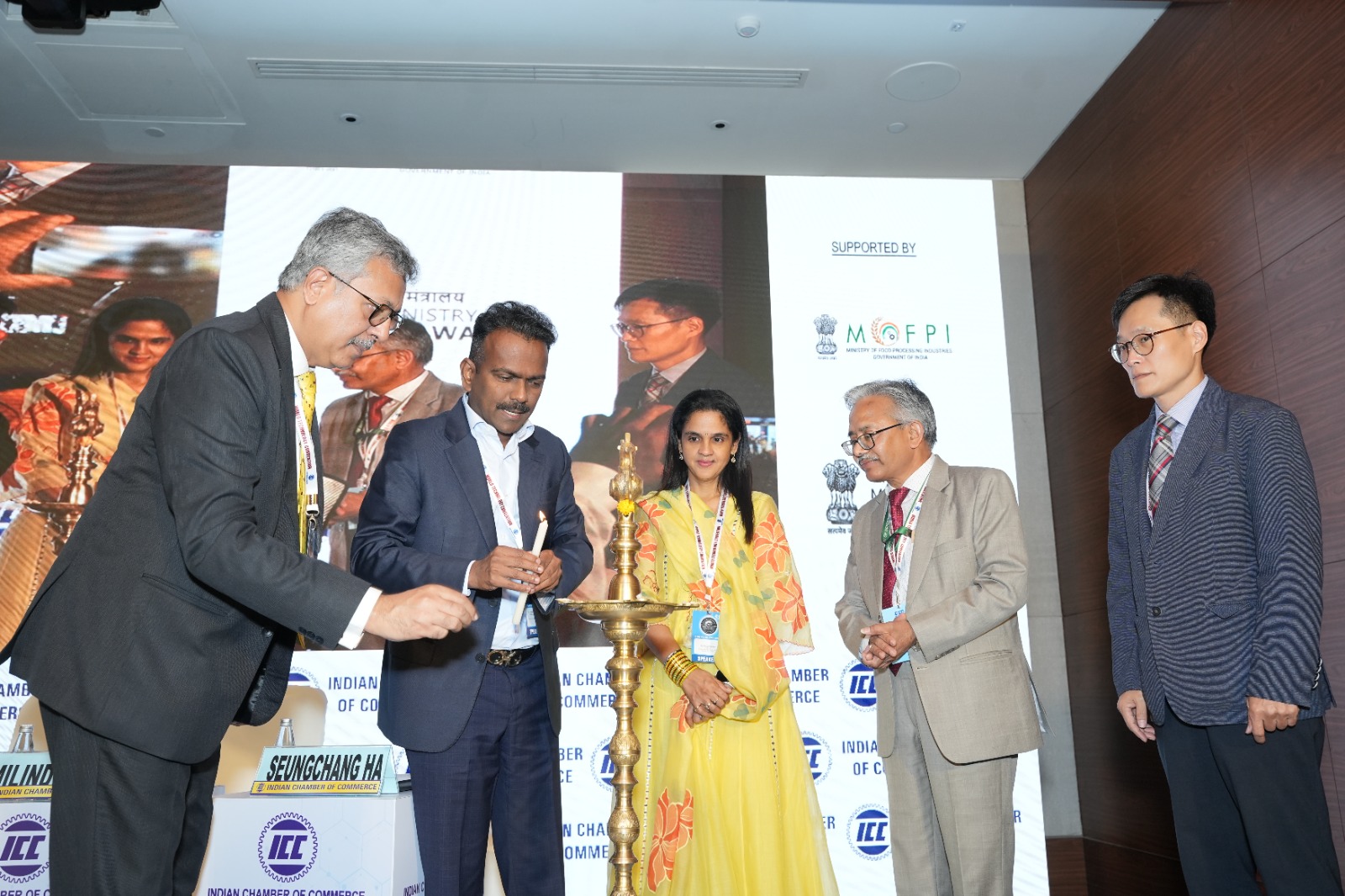
Mumbai, May 09: The Indian Chamber of Commerce (ICC) today inaugurated the ICC World Technology Convention 2026 at the Jio World Convention Centre, Mumbai, bringing together policymakers, industry leaders, researchers, technology companies and global delegates to deliberate on India’s evolving technology and innovation ecosystem.
The inaugural session also witnessed the signing of a bilateral general area of cooperation MoU between ICC and the Chungcheongnam-do Economic Promotion Agency (CEPA), South Korea, along with an MoU between ICC and IIT Bombay. The partnership with CEPA is expected to further strengthen business engagement and bilateral trade relations between India and South Korea, while the collaboration with IIT Bombay is aimed at fostering stronger industry-academia linkages across research, innovation, technology development and entrepreneurship.
*Mr. Deepak Bagla, Mission Director - Atal Innovation Mission, NITI Aayog, Govt. of India*, said, _"India's innovation movement has shifted decisively from the top down, and is now being shaped by students in government schools, rural classrooms, and small-town tinkering labs, building solutions to problems they live with every day. The more significant story here is not the growing count of startups. It is the spread of the instinct to innovate, reaching students and communities that were never part of this conversation before. Aspiration and problem-solving are no longer the preserve of metro campuses or corporate R&D centres. The next globally consequential breakthrough may well come from a district-level classroom, and that possibility calls for a serious, coordinated effort from industry, academia, government, and capital to give every young builder a real chance to experiment, fail, and scale."
*Professor Milind Atrey, Deputy Director, IIT Bombay,* said, _“Research in India cannot remain confined to laboratories. Academic institutions today have to work more closely with industry to convert research into products, startups and technologies that solve real problems. IIT Bombay has been strengthening this approach through translational research, industry partnerships and entrepreneurship-led innovation, and our collaboration with ICC will further help create stronger engagement between academia, industry and emerging technology ecosystems.”
*Dr. P. Anbalagan, IAS, Principal Secretary, Industries Department, Government of Maharashtra*, said, _“Maharashtra is focusing on building a business environment that supports manufacturing, technology and long-term investments. The state is seeing strong momentum across sectors such as electronics, EVs, aerospace, semiconductors, GCCs and data centres, backed by infrastructure expansion, policy reforms and faster approvals. Our effort is to make the state globally competitive and create growth beyond traditional industrial clusters.”
Speaking on the growing business engagement between India and South Korea, *Mr. Seungchang Ha, Chief Representative, CEPA India,* said, _“There is growing interest among Korean and Indian companies to work together across manufacturing, automobiles, electronics and startups. The partnership between CEPA India and ICC will help companies from both countries connect more directly and explore long-term business opportunities.”
*Dr. Sasmit Patra, Member of Parliament Rajya Sabha, Odisha,* said, _“The future of mining cannot be driven only by extraction and production targets. The sector will increasingly be judged on transparency, environmental accountability and community engagement. Parliamentary discussions around mining governance are already raising concerns around monitoring, compliance, water management and sustainable resource utilisation. Technologies under the Mining 5.0 framework such as AI-driven compliance systems, satellite monitoring, digital mine twins and predictive analytics can help the industry address these concerns more responsibly. The mining sector must recognise that growth today cannot come at the cost of local communities and environmental trust. In an era shaped by social media and public scrutiny, responsible and technology-led mining practices will define the sector’s long-term credibility and acceptance.”
*Mr. Mangal Lal Chand, Distinguished Scientist and Director General, Technology Management, DRDO,* said, _“India’s defence ecosystem is moving towards greater collaboration between industry, academia, startups and research institutions. Deep-tech areas such as drones, semiconductors and advanced electronics will play a major role in the future of indigenous defence manufacturing. The focus now is on developing technologies in India, strengthening intellectual property creation and supporting products that can serve both domestic and global markets.”
*Dr. Rajeev Singh, Director General, ICC,* said, _“Technology is changing every sector and creating new opportunities for collaboration between industry, academia and governments. Through the World Technology Convention, ICC is bringing together stakeholders from across sectors to exchange ideas, build partnerships and discuss how India can strengthen its technology and innovation ecosystem further.”
Other eminent dignitaries addressing the inaugural session included Major Vineet Kumar, Founder & Global President, Cyber Peace; *Mr. Deepak Bagla, Mission Director, Atal Innovation Mission, NITI Aayog; Mr. Anil Razdan, Former Secretary, Ministry of Power, Government of India; Dr. Kalirajan S, Managing Director, EDF Nuclear Project India Pvt Ltd;* and representatives from sectors including energy, mining, defence, fintech, healthcare, cybersecurity, logistics and higher education.
Day one of the convention focused on the role of technology across core industries, manufacturing and public infrastructure under the broader theme of ‘Technology for Make in India’. The sessions covered areas such as Energy & Greentech, Mining 5.0, Defence, Aero & Space Technology, Agritech & Foodtech, MedTech, FinTech, Cyber Risk and Education Technology, along with dedicated state sessions and B2B meetings. Discussions through the day centred on deep-tech adoption, AI-led industrial transformation, cybersecurity, indigenous manufacturing, sustainability, digital infrastructure and industry-academia collaboration across sectors. The day concluded with the ICC Technology Excellence Awards recognising innovation and technology-led initiatives across industries.